
February 2026
Ten stories picked by Kathryn Reese

Bio: Kathryn Reese is a queer writer living on Peramangk land in Adelaide, South Australia. She works in medical science and enjoys road trips, hiking and chasing frogs to record their calls for science. Her poems are in The Engine Idling, Temple in a City, Crowstep and Red Room Poetry. Flash in Glassworks, Wigleaf & Literary Namjooning. Collaborative writing in Gone Lawn, Midway Journal & Many Wor(l)ds.
Instagram: https://instagram.com/katwhetter
Bluesky: @kathrynreese.bsky.social
If you aren’t familiar with her work, here’s one of her pieces to start things off:
Storm Season (Kathryn Reese | Literary Namjooning)
Why I like it (MK): This is so beautifully written within the lyrical. I love the rhythm of it, the poetry to it, how every word evokes story and character. Then there’s the swell of emotion and the quiet power within that, a yearning that builds and builds towards that brilliant final paragraph and its repeating “no-one”, how at that point the rich creativity of the writing is allowed to explode to its highest point.
The Sea (Caylin Capra-Thomas | Wigleaf)
Why I like it: the layers of myth (creation, lovers, the wizard of Oz) - a story held in a story. I love the sparse, speculative dialogue. “The more you stay away, the less you belong” is a statement that risks telling, but here it washes in only to recede again (“Is that true?”) and become one of many currents swirling through the piece.
To the Sabre-Toothed Tiger Cub Found in the Permafrost (Eliza Marley | Magpie Zine)
Why I like it: I read this aloud--I love the soundplay: “into the earth, birthed and interred” and “your body downy soft like a womb” (the simile made surprising by the movement of the vowel sound). The story (a single sentence!) is itself a museum holding not just skin and bones but earth and a record of climate, exquisitely curated.
This is Milkweed (Ani King | Exposition Review)
Why I like it: This is another sort of curation: wild attention to wild things. It navigates a complex landscape (thistles, flowers, fire, postpartum depression, conservation) both present and remembered, in a tone that holds just the right amount of intimacy.
PROMPT: Clean out your car or pack it for a journey. Make a story with what you excavate or choose to take.
Eleven Studies of Snagged Edges (Alice Ahern | Does It Have Pockets )
Why I like it: I love the form used here, seeing the same thing over and over in different ways. The way it allows for expansion, contraction, lingering, is especially suited to a work about grief snagging attention.
Sixteen Steps to Reach a Point of Singularity (Mandira Pattnaik | Does It Have Pockets)
Why I like it: I love the progression here from static attention through action (I love the agency the speaker allows herself) to a momentum that’s sensual and dizzying. I’m very interested in the absence of “I” and the sparse & careful use of “you” …watch where the “you” appears in the trajectory of this piece.
The 7-11 that Exists in Every Reality (Lynne Beckenstein | Split Lip)
Why I like it: The way this piece moves back and forward through time, without a formal structure to clue the reader in. It’s just one paragraph and super strong setting. I also like the risk the author takes in the third sentence: “Let me say clearly that these are metaphors for the uterus” - there is both so much hidden away here and so much revealed.
PROMPT: Move through one of your daily rituals. Interrogate why it is you do this thing, this way. Write a story remembering.
And Now I Feel the Benevolent Light of Marie Kondo Upon Me (Cole Beauchamp | Frazzled Lit)
Why I like it: banging title. The sing-song “never have I ever” that feels so familiar. The turn that I think is the turn, from discarding the old to acquiring a new thing. Then it turns, harder, to a wonderful, surreal, unexpected ending.
La Isla Se Mudó (Alessandra Gonzalez | Meniscus - p73)
Why I like it: so often we write about grief and loss—that’s necessary, important, vital—but this little piece contains so much joy, resilience, persistence.
PROMPT: Write about the things that bring you joy. The silly ridiculous things no-one else will understand. Loop one into another until you’ve made a daisy chain. (Hint: if you get stuck, make it up. Let yourself have the spotted alien-space-flowers.)
Things I Observe at my Joint 18th Birthday Party (Orli Baumgart | The Turning Leaf Journal)
Why I like it: this is a vivid and real-I-feel-it-in-my-bones portrayal of depression and celebration. It’s also a stunning example of what a list can carry when it’s built with connections so tight they seem obvious. The way I leave the piece with a sense of having lived through that party, as if I spent hours there, not minutes reading.
How to Eat Like You Belong (Anjali Menon | Jade & Compass)
Why I like it: another feast of unbelonging, this one served in neat courses. Again I can’t stop thinking about joy and what persists, even despite our efforts to change. And the delicious messiness of crab simmered in coconut milk and spice, sucked from its shell.
What did you think of these choices? Please feel free to share your thoughts in the comments - have you found a new favourite piece? Did you try out one of the prompts?
Next month’s selection will be chosen by Mizuki Yamamoto and will be appearing (fingers crossed) on the 17th March.
The Yorkshire Writing Retreat: with Matt Kendrick and Ruth Brandt
Tuesday 8th – Monday 14th September 2026 in Thurlstone (Holme Valley)
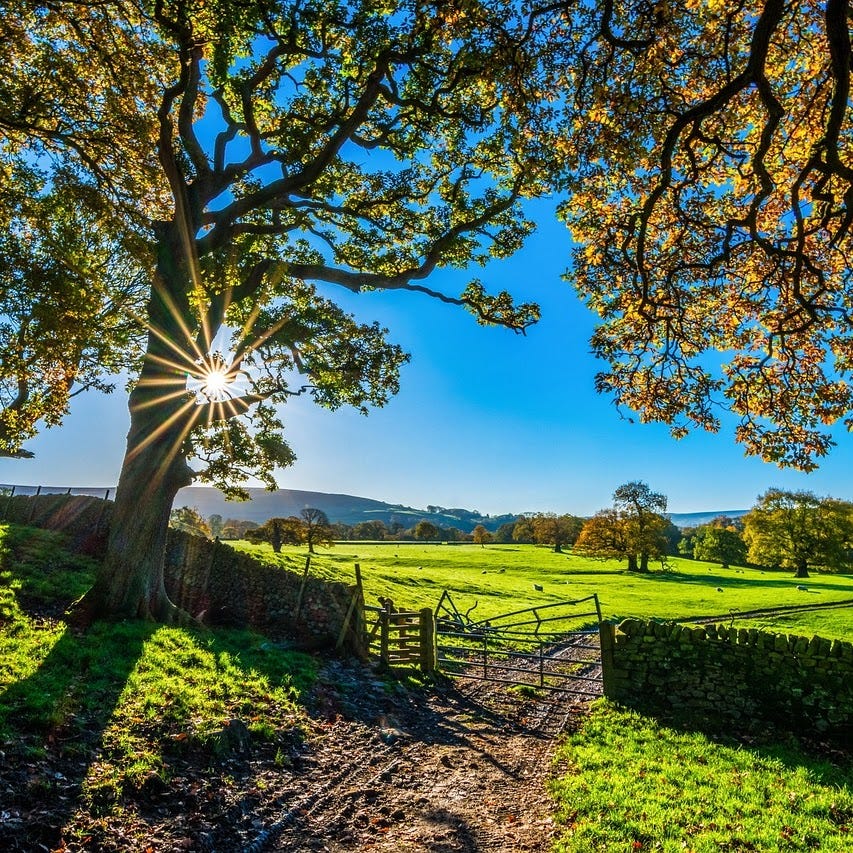
Join us in the idyllic landscape of the Holme Valley for a six-night writing retreat where you’ll learn from two widely experienced creative writing teachers through a series of workshops, feedback sessions and one-to-one chats. You’ll also have plenty of unstructured time dedicated to putting new words on the page.
This is a chance for you and your writing to take centre stage. As such, you’ll be encouraged to structure your stay according to what works best for you. Everything is entirely optional. You might want to go out and explore the beautiful countryside. Or you might prefer to find a comfy corner of the cottage where you can snuggle up and write.
In the evenings, there’ll be social activities like informal readings or writing bingo, but again, these are entirely optional. With everything on the retreat, you do you. Our aim is that your stay becomes whatever you need it to be to feel creatively energised and replenished, and that you come away from your experience having conjured plenty of new words and made some wonderful writing friends.